
Beans, Beans, the Musical Fruit
Posted on May 9th 2018 in Nutrition 101
Sometimes I am quite surprised about the dowdy and awkward image that peas, beans, and lentils seem to have nowadays. Maybe even you have found yourself expecting bloating and flatulence after eating dishes with beans or lentils in it. Do you remember the playground rhyme I quoted in the title? Well, I found out that it can have a different ending too. Instead of “…the musical fruit” it says “…they’re good for your heart!” I want to add: “and so much more”!
I will try to explain the origins of some of these prejudices and provide scientifically sound information on why we can and should trust these little things instead. Just because I personally have learned to love beans, does not mean that you feel the same about them, though. But I sure hope that I can somewhat convince you with my arguments so you may learn to feel the same.
Why are Beans so Healthy?
The Macronutrients
Beans, peas and lentils (also called legumes or pulses) are natures protein-rich nutrient bombs. Although quantitatively less, the protein availability and quality is almost comparable to that of animal proteins found in eggs, dairy, meat and fish. When properly prepared however, pulses contain many healthy substances not found in animal products plus no unhealthy substances like cholesterol or trans fatty acids, that unfortunately are found in animal products.
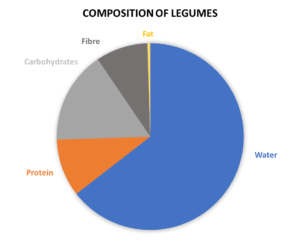 When boiled, beans have a water content of about 60%. The other components are about 25% carbohydrates (1/3 of which is fiber), about 10% protein and less than 1% fat. With just barely above 100 kcal per 100 g (about 1/2 c) they are quite low in calories and in combination with the low fat and the high fiber content perfectly suited for a good saturation on the way to a healthy body weight.
The Micronutrients
Compared to the rather big amounts of macronutrients in foods, micronutrients are only found in such small quantities that they for example do not appear in the diagram above. However, the vitamins, minerals and trace elements in this nutrient group are incredibly important for all sorts of functions in the body and therefore particularly interesting.
On average, only half a cup cooked beans already covers 1/3 of the daily requirement for folate (vitamin B9) as well as many other B vitamins. In addition, the same amount provides 15% of the magnesium, 12% of the zinc and 10% of the iron needed, some calcium and vitamin K. Of course, the nutritional value of the variety of beans differs slightly, but in order to give you a quick overview, I took the mean of all legumes listed under “Quick Food Science” (below) to give you an approximate ballpark figure.
Health Promoting Properties
Now that I’ve named some of the key components, I want to talk about their effects. I was quite surprised at how many wonderful health benefits the various legumes can have on our bodies. In order for you to dig a little deeper if you like, I always included the links to the original sources.
The more beans we eat, the more our risk of developing cancer and chronic diseases (like diabetes, cardiovascular and lung diseases) decreases. It is not only important to simply eat more legumes, but to replace unhealthier foods with them. Substituting eggs or meat with only two tablespoons of cooked beans for example already significantly reduces the risk of developing type 2 diabetes and other cardiovascular diseases. Imagine what larger amounts can do! In a large-scale global study, the death rate was reduced by 8% with every two tablespoons of beans. The groups of people who had the best health in this study had one thing in common: They ate the largest amounts of legumes in comparison to all others. So don’t settle for a mere 8% improvement! The more the better.
You might have been wandering earlier about the seemingly big amount of carbohydrates found in pulses. But most important is that they contain a large proportion of super healthy fiber. There is so many reasons why fibre is so good for us! I promise to go deeper into that topic in one of my upcoming articles. For now it is important to know, that fiber in beans lowers our bad cholesterol significantly. And the rest of the carbohydrates are not as bad as some low-carb-fanatics might fear. In fact, they are all complex carbohydrates, which along with all the other healthy legume ingredients make for a very low glycemic index (GI = rise in blood sugar level).
And here comes the next big thing. Beans do not keep their beneficial effect on our insulin levels for themselves. They share it with other foods we eat. Yeah, that’s right. For example, eating white, polished rice would lead to a pretty high GI and a spike in our blood sugar levels. However, eating that same rice with beans will reduce the glycemic stress considerably.
And in case my arguments so far were not convincing enough, here is a research result that absolutely knocked me off my socks when I first heard about it. Here it comes: Beans not only influence the resorption of their own nutrients positively, but also those of the next one. It has been discovered that the intestinal bacteria, that enjoy the bean residues of the past meal along the last phase of the digestive tract, excrete substances that positively influence the resorption process of the next meal. So if beans are part of my dinner, even a sugar-rich breakfast will be less of a burden on my blood sugar level than without beans for dinner. This should not be an excuse for unhealthy breakfasts, but it’s great news! Not only for Type 2 diabetics, who might get rid of their disease through a healthy diet and lifestyle, but also for people with type 1 diabetes, whose illness will accompany them for the rest of their lives.
Quick Food Science
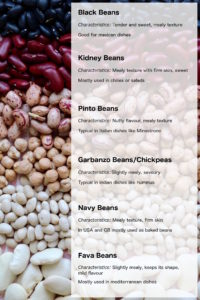
Let’s get down to the dry basics. Or cooked basics? Either way… Down below, you will find a short overview of some of my favorite beans. Lentils of course are also legumes, but this time I wanted to focus on beans only. Besides, there is already a lentil-recipe with some info on my blog, the english version will be coming soon. So if your german is good enough, just take a look here. 😉
In the overview below, you find a few of my favorite beans that are staples in our home. I also jotted down a few characteristics, as well as where and how to use these little things. From a nutritious point of view it makes almost no difference whether you buy canned beans that you just need to rinse before use, or if you buy dried that need to be soaked and cooked. The advantage with the canned version is clearly the factor time, because as mentioned before, soaking dried legumes takes at least 8 hours and then they have to be cooked for up to an hour. But canned beans also have a few disadvantages. Manufacturers usually add salt or other additives, which you can omit when soaking and cooking them in your own kitchen and pot. Canned beans also usually cost a bit more than dried, because someone else has already done the work for you.
How to cook beans from dry
I generally have both in my food storage, canned and dried. Sometimes it just has to go fast, then I open a can. But when I think ahead about which beans I want to use the next day, then I quickly cover the beans in plenty of cold water, leave them be overnight and then cook them in the morning in my pressure cooker (instant pot works too). That only takes 15 minutes instead of one hour if you would cook them in a normal saucepan. By the way, always calculate half of the amount if using dried beans. Say a recipe calls for 430 g of beans (equivalent of whats inside most cans around here), then I have to soak about 220 g. If you are working with cups, it works the same. If you need one cup of beans, just soak half a cup.
Nowadays you can find countless recipes for dishes with beans and lentils online. Maybe you even have a favorite recipe in your own collection already? In any case, I want to help you to integrate these healthy, small nutrient packages into your diet. Therefore, I promise you that next time I will provide you with a scrumptious recipe in which I will use legumes. Small preview: It will be a recipe perfect for cold days. I might almost be too late for that, because here in Switzerland, spring has already come. But I hope you don’t mind. Here is a link to the german version, that’s out already.
So here are the beans, but where is the music?
Maybe you are already wondering: Hey Ronja, where is the info about beans and farting? I could be less vulgar and call it flatulence or wind, but one thing remains unchanged: too much of it is really uncomfortable and can be super embarrassing. But no matter how much this topic may be frowned upon, there are still scientists who are worried about it. Especially when it comes to beans and their impact. Here are my research results.
Of course, every body reacts differently to all sorts of foods, including beans. However, researchers have found out that only a small fraction of humanity actually suffer from an increased amount of wind after a meal with beans. And if these few people start eating a small portion of about a half cup of pulses per day, then over 70% of them will not have any problems any more after 2-3 weeks. Our bodies, more specifically the microbes in our large intestines get used to the beans.
The substance in the beans that causes bloating in our bodies are certain carbohydrates, that some not so nice bacteria in our large intestine use to produce gas. However, as the composition of the population in our intestines depends on the food we give them, they can be changed for good or for worse, depending on what we eat. Health-promoting bacteria get supported by the good fiber and carbohydrates in beans and oust the flatulence-causing bacteria. Voilà, by eating them regularly, I can tolerate beans without embarrassing myself and enjoy all the health benefits they give me.
In addition, the same researchers made the observation, that a large part of the excessive fear of beans and lentils originates from a placebo effect. If the patients were told they were eating beans, but were actually served meals without, they would complain of increased flatulence nonetheless. So all we have to do is learn to no longer trust the old nursery rhyme I used as the title of my article. Or maybe we should simply just remember the alternative phrase: “Beans, beans, they’re good for your heart.” Well, that sounds so much better.
Another trick to avoid excessive flatulence: Always rinse beans under fresh water before eating, no matter if using the canned or the home-cooked version. This simple trick might really help especially in the beginning of getting used to beans, because most wind-generating carbohydrates will leak into the cooking water, which you should therefore get rid of.
On this note: